Mardi Himal Trek
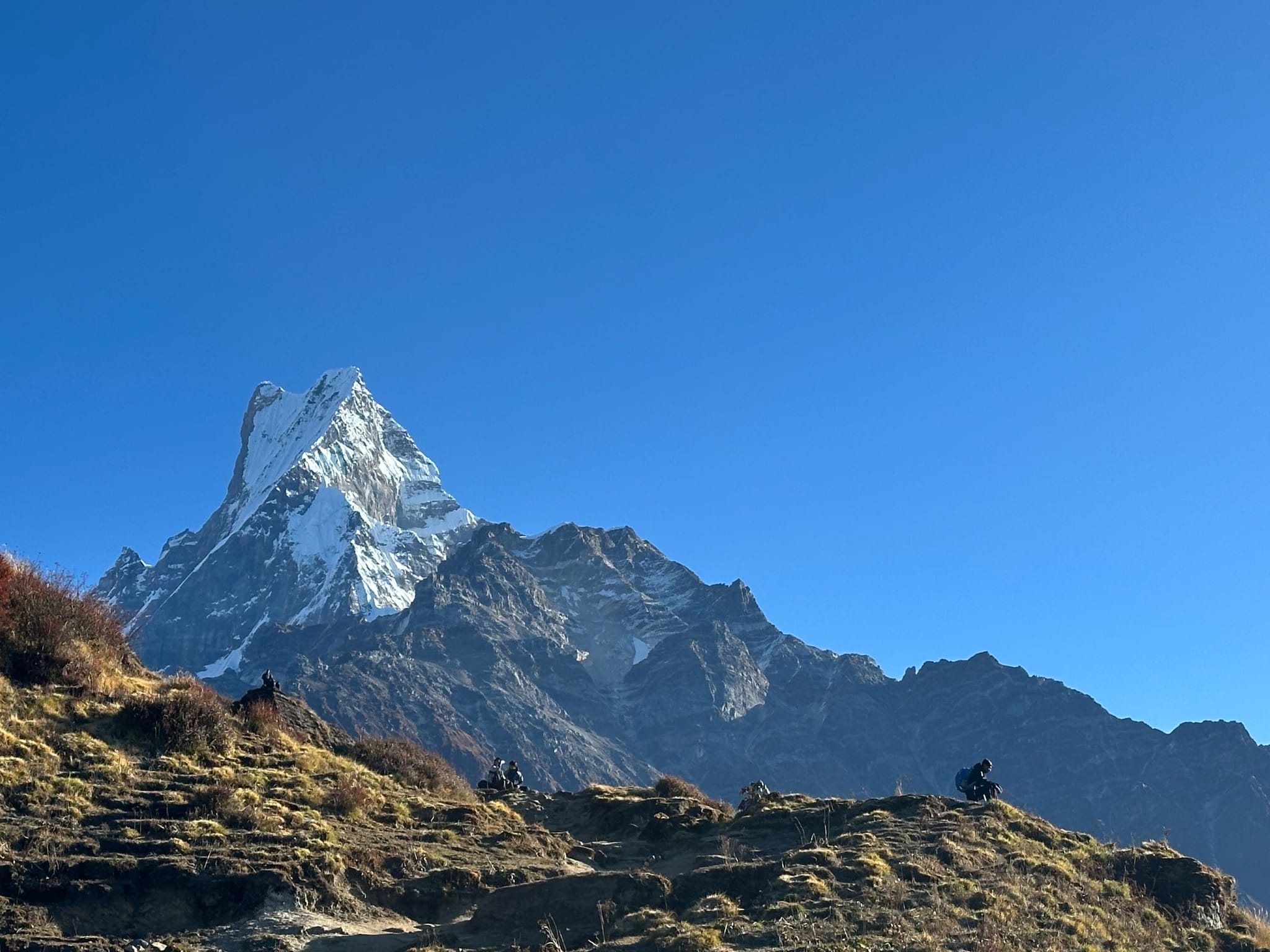
A short, steep ridge walk straight at the fishtail summit of Machhapuchhre — the best mountain-to-effort ratio in Nepal, and only a few days out of Pokhara.
Trip Overview
- Best season
- Spring · Autumn · Winter
- Group size
- 2 – 12 People
- Start & end
- Kathmandu-Pokhara
Highlights
- Stand beneath the unclimbed south face of Machhapuchhre at 3,580m
- Climb to the Upper Viewpoint at 3900m for an Annapurna panorama
- Walk a continuous forest ridge instead of a valley floor
- Short enough for a one-week trip, with no internal flights
- Quieter trail than Annapurna Base Camp or Poon Hill
- Starts and ends in Pokhara, by Phewa Lake
About this trek
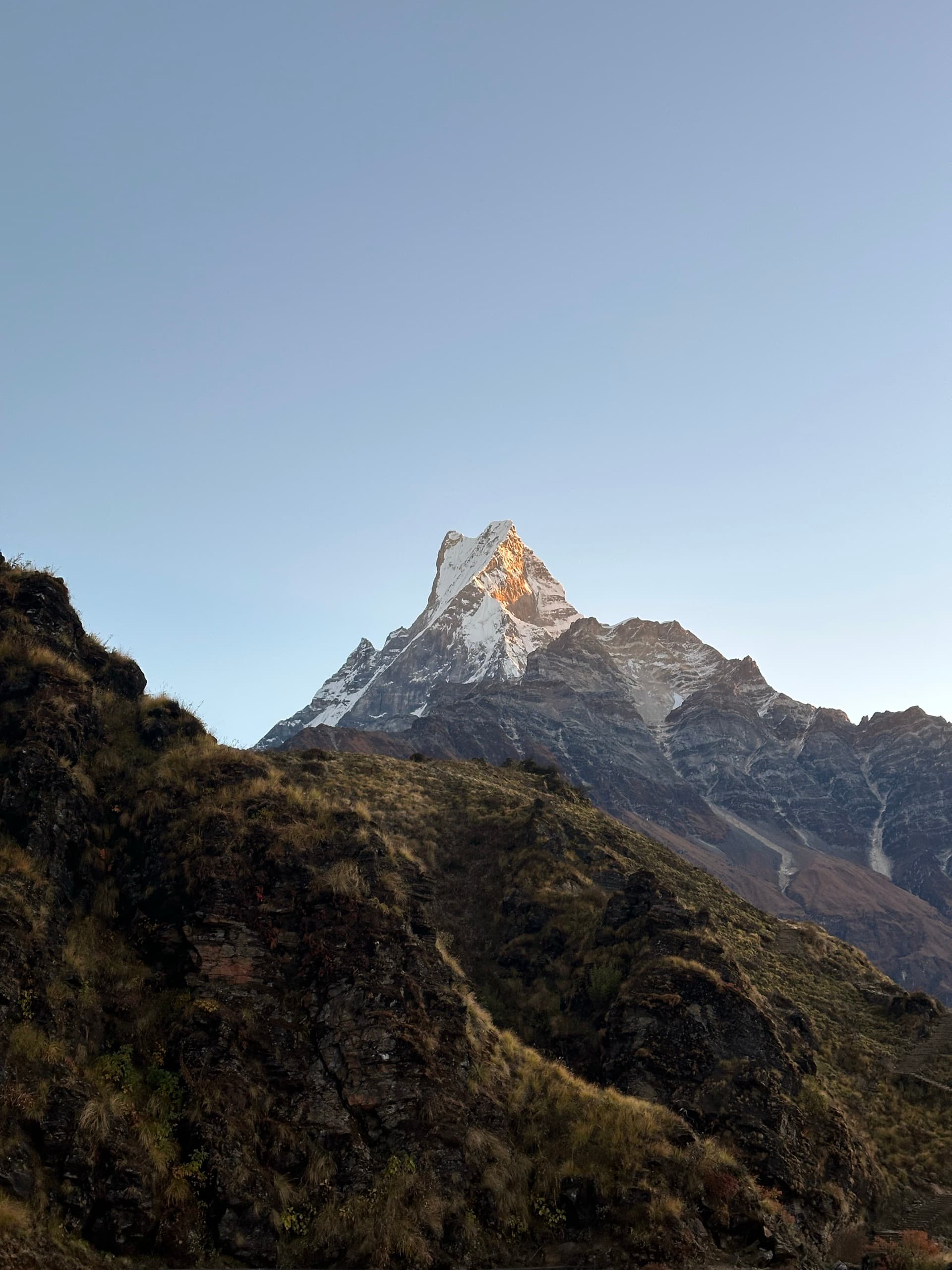
The Mardi Himal trek is the newest of the Annapurna region’s classic routes, only opened as a teahouse trail in 2012, and it has become popular for a simple reason: no other short trek in Nepal puts you so close to such big mountains. The route follows a single forested ridge north from the Pokhara valley, climbing through rhododendron and oak into high alpine meadow, and finishes on an open crest beneath the south face of Machhapuchhre — the sacred fishtail peak that is closed to climbers and has never been summited.
Because it never enters a gorge, the walking is almost entirely on ridgeline, and the views open earlier and stay longer than on the better-known Annapurna Base Camp or Poon Hill routes. From High Camp and the Upper Viewpoint the skyline is filled by Machhapuchhre, Mardi Himal, Annapurna South and Hiunchuli, close enough to pick out individual ice flutings on their faces.
It is a short trek but not a soft one. The daily height gain is substantial, High Camp sits at 3,580m in genuinely cold air, and the climb to the Upper Viewpoint at 4,500m is a long, exposed push on a narrow ridge. The teahouses are small and basic by Annapurna standards, which is part of the appeal — and the trail is still noticeably quieter than the main circuits, particularly in the lower forest.
Starting and finishing in Pokhara with no internal flights and no restricted-area permits, Mardi Himal is the natural choice for anyone with a week or less in Nepal who still wants to stand under the high Himalaya rather than look at it from a distance.
Day by Day Itinerary
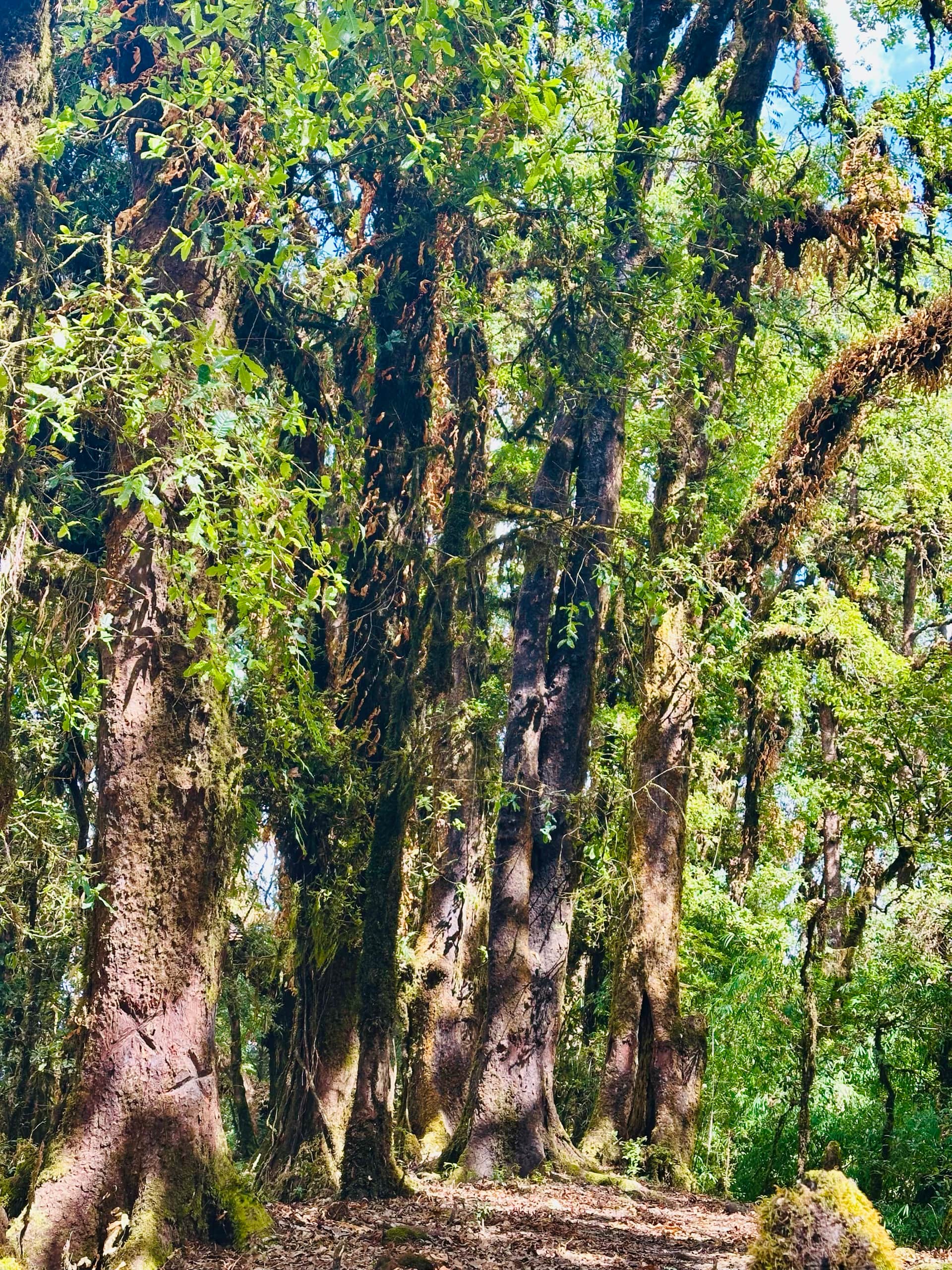
An hour’s drive from Pokhara brings you to Kande at 1,770m, where the trail climbs immediately through Australian Camp and Pothana — both with wide views back over the valley. Beyond Deurali the route turns north onto the Mardi ridge and enters dense, mossy rhododendron and oak forest, following it to the small lodges at Forest Camp.
A short but continuously uphill day through old forest hung with lichen, where the canopy occasionally breaks to show how much height you have gained. Low Camp sits right at the top edge of the tree line, and Machhapuchhre appears suddenly and very close as you arrive.
Leave the forest behind and climb the open ridge through rhododendron scrub and alpine grass, passing Badal Danda — "cloud hill" — with the ridge narrowing and the drop on either side growing. High Camp is a handful of simple lodges on an exposed crest directly beneath the fishtail. Cold, windy and spectacular.
An early start for the long climb along the ridge to the Upper Viewpoint at 4,500m, close under the south face of Machhapuchhre with Annapurna South, Hiunchuli and Mardi Himal across the valley. The last section is narrow and exposed; your guide will turn back early if there is fresh snow. Return past High Camp and descend to the gentler meadows of Badal Danda.
Leave the ridge on the eastern descent, a long drop through forest and then terraced farmland to the Gurung village of Siding. It is a different landscape entirely from the way up, and a quiet, rarely-walked trail.
A short walk or jeep ride out of Siding to the road head at Lwang, then the drive back down the valley to Pokhara, arriving around midday. The afternoon is free by Phewa Lake, with the mountains you just stood under visible across the water.
Route & Elevation
Trip Map
9 stops · 8 places · 820–4,500 m
Pokhara
820m
Kande
1770mDrive
Forest Camp
2550m
Low Camp
2970m
Badal Danda
3210m
High Camp
3580m
Upper ViewpointHigh
4500m
Siding
1750m
Pokhara
820mDrive
Elevation
Photographs
What's Included
Included
- Private vehicle transfers between Pokhara and the trailheads
- All meals during the trek (breakfast, lunch, dinner)
- Teahouse accommodation on a twin-share basis
- Experienced English-speaking trekking guide
- Porter service (1 porter per 2 trekkers)
- ACAP permit and TIMS card
- First aid kit and pulse oximeter
- Government taxes and official paperwork
Not included
- International flights
- Nepal visa fee
- Travel and high-altitude rescue insurance
- Accommodation and meals in Pokhara
- Personal trekking equipment and clothing
- Tips for guide and porters
- Hot showers, WiFi, charging and bottled drinks
Good to Know
Permits, insurance, altitude and the rest of the small print.
The trip starts and ends in Kathmandu so make sure to book the flight accordingly. You can book any flight you want that fits your trip's start and end date. However, it is good to arrive before 3 pm local time so that you can make it to the group meeting and welcome dinner.
Visas are available upon arrival at the airport in Kathmandu. When you arrive, you will fill out a form first at a kiosk and then proceed to a banking desk where you will pay the Visa fee (USD 50 for 30 days US$30 for 15 days). You might be able to pay with a credit card, but bringing cash (USD) with you expedites the process. With that receipt and the form you filled out, you will proceed to the immigration officer who will issue you a visa. During the peak tourist season, the immigration desk can get congested, which can be a hassle.
You don’t need a photo for your Nepal visa, but you will need one for the trekking permit. You can either bring a passport-sized photo from home or have one taken and printed in Thamel.
Look out for our airport representative holding your name and Junkiri sign at the end of the terminal hall. He will then drive you to the hotel.
We will arrange all ground transportation as outlined in the itinerary, using private or public vehicles as appropriate. Transportation may also be adjusted according to the requirements of the trip.
The cost for Mardi Himal Trek depends on your personal preferences and appetite. As a general guideline, it is recommended to budget around US$35-40 per day for expenses such as meals, chocolates, showers, internet, and drinking water. Accommodations, internal flights, staff and their wages, national park fees are covered.
You’ll need one permit:
- ACAP : Annapurna Conservation Area Project
If you’re trekking during the peak season, you can expect favorable conditions. However, it’s important to be prepared for unexpected changes, including rain, clouds, and even snow, even during the peak season.
Unpredictable weather patterns, influenced by global warming, have made it harder to predict conditions in recent years. To ensure a smooth trekking experience, pack accordingly and stay flexible with your schedule.
Trekking to the Everest Region is a great experience, but safety should always come first. It is very essential to follow your guide's advice regarding your pace, hydration and food. It is equally important to carry essential trekking gear such as a first aid kit, proper trekking gears, layers for different temperatures, and energy bars as backup meals. Similarly, follow the trail etiquette by sticking to the marked trail, and keeping to the mountain side when passing by yaks and mules. Do not use headphones and earplugs. Respect your limits, listen to your body and mind, pace yourself, take rest when you feel like taking. Stop pushing yourself beyond your physical abilities.
All the accommodations are on a twin-shared basis. You will get standard accommodations with breakfast in Kathmandu. In the mountain tea house/lodges, accommodations are pretty basic with toilets and bathrooms shared, and outside the room. At base camp, the tea houses are more basic and colder than those of lower altitudes.
We provide one lead guide for the entire group and an assistant guide for every four participants. Porters are assigned at a 1:1 ratio. Their daily wages, insurance, and accommodation are fully covered.
Nepal has a diverse and rich culture that is heavily influenced by its history, and religion. As a tourist, you may encounter locals who approach you to chat, take pictures, or sell goods.
The roads in Kathmandu are busy most of the time so you might get stuck in traffic jams whenever you take local transportation. It is not uncommon to see cows, and dogs in the middle of the roads, beggars around the temple, and street children in the streets of Thamel. Please refrain from giving money and food to these people.
The local vendors try to charge higher than the normal price. So make sure you have a good deal before you pay for whatever you want to buy.
However local restaurants have fixed prices for the meals they serve so no need to bargain the cost.
Local restaurants close after ten and bars but pubs remain open all night but it is good to go to bed before 10 pm.
Locals you meet in the pubs and bars are usually friendly and helpful but they can be rude sometimes depending on how you treat them. To stay safe, it is strongly advised that you remain sober and avoid consuming excessive amounts of alcohol.
As you hit the trail, the tapestry of the mule train, prayer flags, suspension bridge, and mane walls bring you lots of energy and excitement. Morning offers stunning views and fresh air while evening provides the opportunity to be social, by the fire talking to your fellow trekkers, playing cards, riddles, or other fun games. But as you go high, the terrain becomes rugged, dry, and hostile, testing your body and mind. Even a backpack you have been carrying starts bothering you. Now you have ten reasons to quit but you must propel yourself. Don’t lose hope and follow your dream. Let your mental and physical resilience guide you. Believe in yourself and try to get the best out of what is before you, and you will have the experience of a lifetime.
A typical day begins between 8-9 am depending on the length you are to cover. After walking for a couple of hours, there is a tea break, followed by a lunch break at another place. Upon reaching the overnight lodge, check in your room, freshen up, and gather in the dining hall. Sit around the warm chimney, and order dinner, served between 6 and 7 pm. After dinner, you will get the briefing about the next day and play cards, riddles, and other fun games.
Common Questions
It is roughly half the length and stays on a ridge rather than entering the Modi Khola gorge, so the mountain views start earlier and are almost constant. Annapurna Base Camp puts you inside the sanctuary surrounded by peaks; Mardi puts you on a crest looking straight at Machhapuchhre. Mardi is shorter, cheaper and quieter; ABC is the bigger landscape.
No. It is an optional out-and-back from High Camp — around 900m of ascent on a narrow, exposed ridge, and the hardest few hours of the trek. Many people stop at the Lower Viewpoint instead, which still has an excellent view, and your guide will turn the group back if there is snow or ice on the crest.
At 3,580m on an exposed ridge, night-time temperatures fall below freezing for most of the year and well below in December and January. The lodges have no heating in the bedrooms. Bring a sleeping bag rated to around -10°C, a warm down layer, hat and gloves.
An ACAP permit and a TIMS card, both of which we arrange. Mardi Himal lies entirely within the Annapurna Conservation Area, so no restricted-area permit is needed.
You should be comfortable walking 5–7 hours a day on uneven ground, several days in a row. You do not need climbing experience or a gym routine — the people who struggle are usually those who underestimate the daily hours, not those who are unfit. Two or three months of regular hill walking with a daypack is the best preparation.
Do not drink untreated tap or stream water. Boiled water is sold by the litre in every lodge, and we recommend carrying purification tablets or a filter bottle as a backup. Buying boiled water also avoids leaving plastic bottles on the trail.
Ready when you are
Walk into Annapurna
Tell us when you'd like to go and we'll shape the route, the pace and the team around you.
